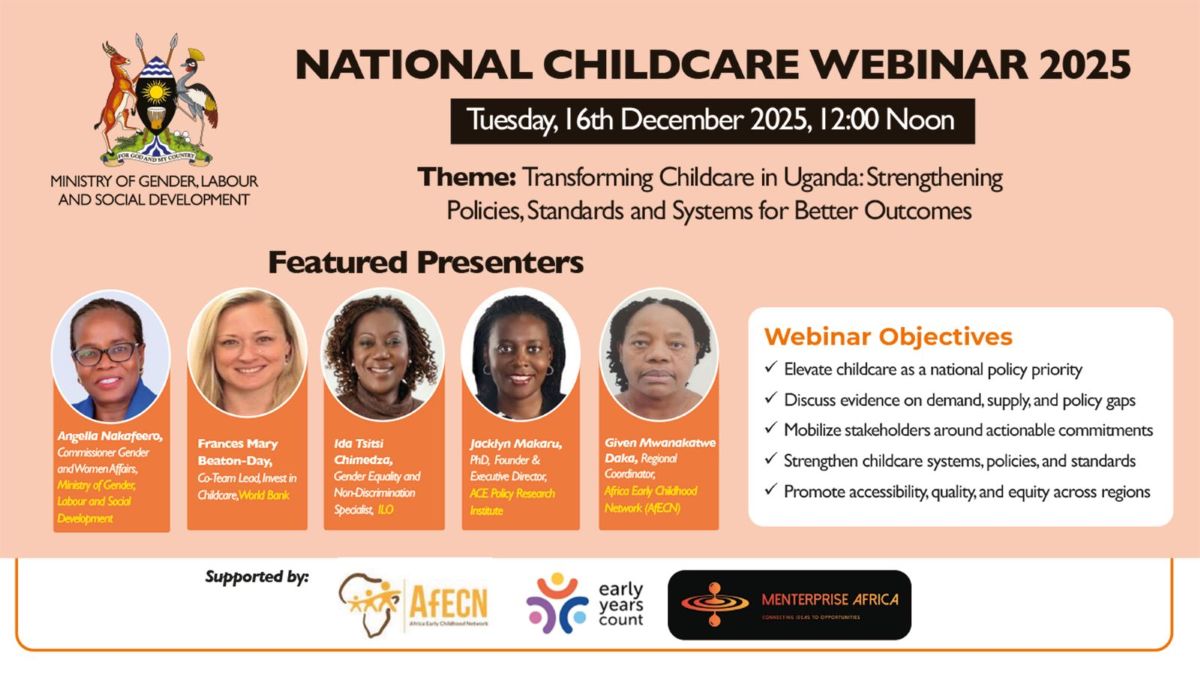
Date: Tuesday, December 16, 2025
Time: 12pm – 2pm EAT
Duration: 2 hours
Language: English
To attend this webinar, register here.

Childcare is an essential foundation for early childhood development (ECD), gender equality, and inclusive economic growth. In Uganda, there are more than three million children under age three need childcare, but fewer than 15 per cent access quality, formal services, leaving many children in informal, unregulated arrangements that may be unsafe or developmentally inadequate. Persistent childcare gaps constrain families, especially women, from fully participating in economic activities and contribute to deepening inequalities in early learning and care opportunities.
Uganda’s regulatory framework for centre-based childcare, especially for under-threes, is evolving, with several studies highlighting gaps in availability, affordability, and quality, despite existing policies.
A recent World Bank demand–supply assessment in Kampala and Wakiso revealed that while most childcare providers were centre-based (80%) and had spare capacity, childcare utilisation remains low mainly due to demand-side barriers — notably cost and accessibility — rather than lack of supply. Many providers could enrol more children but services remain out of reach for low-income families. The same research highlights that only 22% of low-income women entrepreneurs used formal childcare, with 70% citing affordability as the foremost barrier. Yet 95% stated they would use services if they were affordable and accessible, evidencing strong latent demand.
UNICEF reports many children still missing out on early care and learning opportunities, reinforcing the need for stronger policy guidance and systems integration to support early years services. Additionally, National Planning Authority evidence has consistently highlighted the need for childcare and ECD systems that promote accessibility, quality, and equity across regions and socioeconomic groups, as well as reforms to integrate childcare into national development goals and boost women’s economic participation
Collectively, this evidence reveals three key dynamics in Uganda’s childcare landscape:
- Demand for quality childcare is high, particularly among low-income and economically active women, but is constrained by cost, accessibility, and regulatory challenges.
- Supply exists and has untapped capacity, but quality and regulatory oversight are uneven due to limited standards and institutional coordination.
- Policy and institutional frameworks for childcare under three years are underdeveloped, resulting in services that lack consistent quality, safety benchmarks, and equity safeguards.
Consequently, the Ministry of Gender, Labour and Social Development and the Africa Early Childhood Network are organising the National Childcare Webinar 2025 to leverage this momentum and evidence to elevate childcare as a priority policy area and mobilise stakeholders around shared commitments to strengthen childcare systems, policies, and standards.
Speakers
- Frances Mary Beaton-Day, Co-Team Lead, Invest in Childcare, World Bank
- Ida Tsitsi Chimedza, Gender Equality and Non-Discrimination Specialist, ILO
- Jacklyn Makaru, PhD, Founder and Executive Director, ACE Policy Research Institute
- Given Mwanakatwe Daka, Regional Coordinator, Africa Early Childhood Network
- Angella Nakafeero, Commissioner, Gender and Women Affairs, Ministry of Gender, Labour and Social Development
Register for the Webinar Here!
This National Childcare Webinar is Supported by: