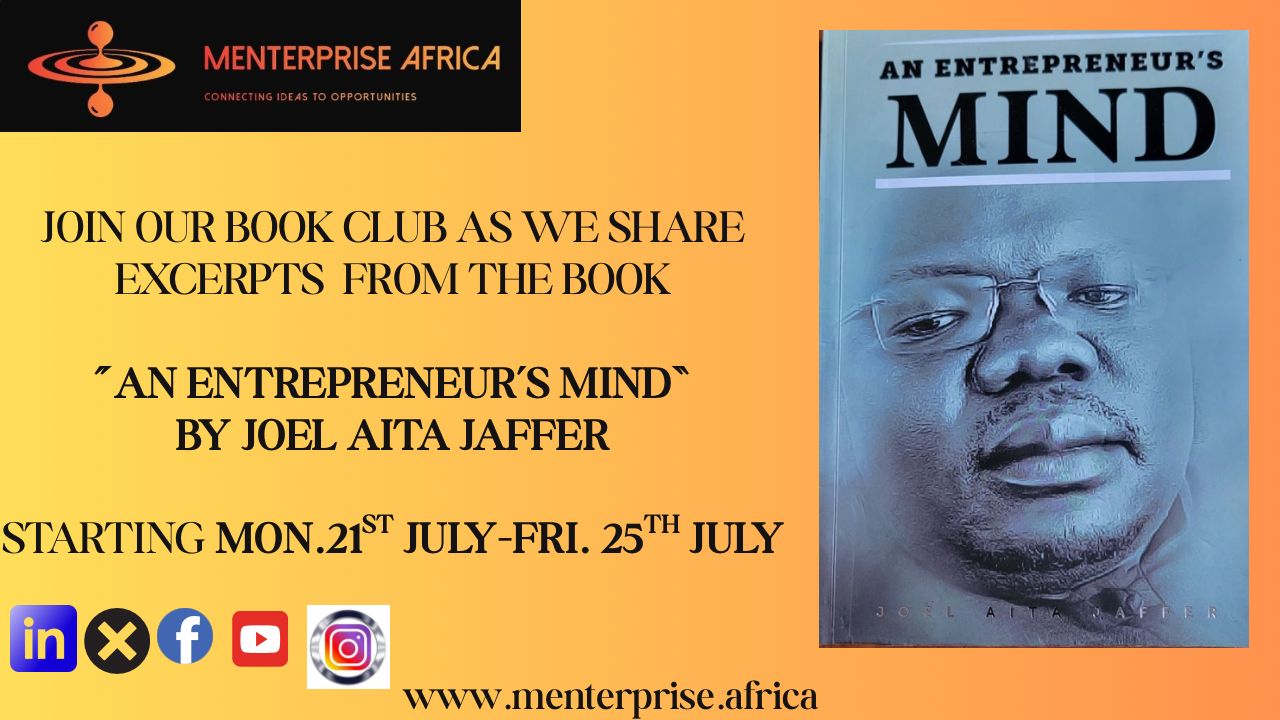
In the fifth and final part of our serialisation of excerpts from The Entrepreneur’s Mind, a book by Ugandan entrepreneur and engineering specialist Joel Jaffer Aita, the Joadah Consult Founder writes about the benefits of partnerships to the growth of enterprises and the eight traits that entrepreneurs should look out for while choosing a business partner.
Creating the perfect partnership takes understanding, significant effort and, above all, a sincere desire to make it work. A partnership, if well planned, comes with huge benefits. It is like hitting the jackpot.
At the start of Joadah Consult, we were engaged in a number of small assignments with districts in the West Nile region of Uganda. These were basically contracts below $20,000 U.S dollars. We realised these kinds of projects would not take us far in terms of revenue and experience. We, therefore, decided to list down the top 500 consultancy firms in the world with whom we would seek partnerships for tenders within the sub-Saharan-Africa. This impacted us positively.
In 2012, we contacted a German consultancy firm that we got to know about on an African Development Bank-funded water and sanitation project in Rwanda. We eventually won the approximately $2,000,000 assignment. However, I felt cheated. Our partners decided to give us only 10% of the assignment, taking all the 90%. At the beginning, I wanted to protest against this injustice, but then I came to realise that 10% was actually equivalent to $200,000, which was a huge increase from our usual $20,000. I consoled myself with the saying: ‘It is better to own 10% of a $2m deal than to own 100% of a $20,000 deal’’. This marked the start of our international engagements.
Before becoming the dean of Yeshiva University’s School of Business in mid-2019, Noam Wasserman was a professor of entrepreneurship at Harvard Business School and a chaired professor and founding director of a centre at the university of Southern California. He studied almost 10,0000 business founders for his book, The Founder’s Dilemma. According to him, business partners can bring you triumphant glory or catastrophic disaster. Ideally, partners contribute diverse skills and talents to their business, providing a sense of wholeness that no one partner could have achieved alone. However, the intensity of sharing a professional identity coupled with the knowledge that your partner is impacting your survival brings huge potential for conflict.
Many of today’s iconic companies were founded by partners and interestingly, investors prefer to invest in companies owned by partners. However, according to Wasserman, 65% of high-potential startups fail as a result of conflicts among co-founders.
Due to the inevitable excitement of starting up a new business venture, one of the most important decisions that is often downplayed by entrepreneurs is: should they run it alone or bring in partners? More than just financial rewards are at stake. Friendships and relationships may suffer. Bad decisions at the inception of a promising venture lay the foundations for its eventual collapse. It is, therefore, an important decision to make for an entrepreneur. Below are some guidelines on whom you should choose to start a business with;
- A trustworthy Person: There is a trust continuum. Trust must flow consistently like the Nile. Any slight sense of mistrust with your partner can ruin the business. Trust is built over time but a slight sense of trust at the beginning is a good path in the right direction. Trust is like an Atom in your business; for without it, the business maybe at stake. If you have not build trust with your partner, then you do not know who your business partner is.
- Someone who shares your values: Successful partners generally agree on standards regarding what is desirable, undesirable, good and bad. Values are one of the biggest treasures to hold onto in life. These values guide their actions judgments and choices. Your values shape your personal and professional identities so they typically carry a strong emotional charge. When partner’s values align (for example, they share a sense of commitment to family, prosperity, ambition, work ethic, or political persuasion), they are more likely to make congruent decisions and remain united.
- Someone with a complementary set of skills and traits: Successful partners always come with a whole new range of different (complementary) skills and traits. The broader the partners’ range of skills, the clearer the division of their labour and output (power) can be. Other necessary variables are often not so apparent. Michael Gerber’s classic book, “The E-Myth”, explains that there are three key roles in every business;
(i) Entrepreneur-the creative visionary.
(ii) Manager-the administrator who brings planning, order and predictability and the
(iii) Technician-the craftsperson.

Partnerships are distinctly full of advantages, in that two (or more) invested people are available to perform these three functions;
- Someone who gives and takes: The law of giving and taking must go hand-in-hand in a complimentary manner when it comes to partnerships. In successful partnerships, each partner believes their rewards are equal or exceed their contributions. Casual acquaintances can maintain this sense of equity by keeping track of the benefits they exchange. However, in long-term and more committed relationships, keeping track is unhealthy. Instead, each partner should have that sense of equity, knowing that some days s/he is giving and some days getting. Each partner must get equal treatment in the context of almost everything.
- Someone who supports massive growth for both of you. From the event of birth to death, each of us is consistently moving through a process of change. Change is inevitable and we cannot avoid it. Sometimes we are not aware of the changes we’re experiencing and sometimes change is viewed as a threat to the status quo. Successful partners embrace change and growth, knowing that this attitude benefits them both individually and as a team. Sometimes in order to grow, you must first experience a terrific breakdown such that your growth will escalate without any limits. It is, therefore, necessary to find a business partner who will understand the importance of growth and the entire processes, if not, you and your partner will break apart, hence, paving way for the business to collapse.
- A partner who has extensive knowledge in proactive conflict management and resolution. When people share a close connection, competing and avoiding are not effective conflict management strategies. In fact, avoid them in whatever way possible. Use those strategies only when no ongoing relationship exists. Instead, successful partners will use proactive and strategic approaches to conflict management such as accommodation, compromise and collaboration to resolve their differences. Everywhere there are differences but choosing how to solve them is all that manners. If you don’t solve these indifferences in an appropriate manner, you have high chances of losing your business partner or the entire business as well.
- Someone who can share your vision. Vision reflects an organization’s desire for the future. Vision enables you to view things from a microscopic perspective. Where there is no vision, there is no focus and direction. Vision enables people to plan ahead – for the future. When partners hold different visions, they can easily become discouraged, overwhelmed and disconnected. In order to create and benefit from a shared vision, four tasks are necessary: creating the initial vision, translating that vision into a set of actions, articulating and selling the vision to others plus holding true to the essence of the vision when reality changes the plans. You must speak the same language of vision with that of your business partner.
- Someone who is prepared for the end. It’s often said that a graceful exit is proof of a successful venture. Without an exit strategy in place, partners can be faced with making crucial decisions at a time when they are least levelheaded. An exit strategy is a shared sense of when and how an alliance will end. A written exit strategy should be included in every business plan. However, even though planning for the end is a critical aspect in business ownership, it is one of the most neglected. An exit is easy to avoid when the issue is not pressing and raising it might sour the deal or suggest a lack of trust. An exit plan should answer four questions: what events might trigger an end to the partnership? How will the business be valued at the end? Which options for future ownership are acceptable? What post-alliance ties and restrictions such as non-compliance need to be included?
Having the right partners around you will give you an opportunity to create results that would otherwise be unobtainable. using these eight strategies to select your next business partner will increase your potential for creating true energy through a partnership that is greater than the sum of its parts. Enjoy the rewards!
This marks the end of our serialisation of excerpts of Eng. Joel Aita’s book. To buy a copy of Mr Aita’s book, please log onto his website, www.joelaita.com, click on the “My Book” section and make your online purchase.